I’m trying to wrap my head around the Resist curve and balance point, but I’m having some trouble. If no equipment is running, wouldn’t the temperature inside always end up being the temperature outside? If that’s the case, I would expect the balance point to be around my set point, but it’s quite a bit lower. Is this because of other sources of heat in the house (like humans, hot water, etc.) or due to solar radiation?
The resist “curve” will show you the point above or below which heating or cooling is required where it crosses the 0F line.
The heating balance point shows you where the heating system can no longer generate enough heat to overcome the loss of heat of the house. It should be considerably lower than your set point. It shows you the temp where additional heating is required.
Because of the insulating properties of the home, with solar radiation and the change in outdoor ambient temps etc., there will always be a temperature differential between inside & out.
1 Like
The resist “curve” will show you the point above or below which heating or cooling is required where it crosses the 0F line.
This is somewhat counterintuitive though, and I think I must be missing something. My resist curve intersects 0F at around 50F, which would imply that I should not need any heating when it’s 50F outside, which is really not true if I want to keep my home above 66F
On the other hand, it also implies that I should need cooling at any point above 50F, which is also not true, since I generally don’t need cooling until it’s at least 80F outside.
My bad on the use of that language. But, it was close. Lol. That 50F point is where the home neither gains or loses temp as compared to the outdoor ambient temp. It is the point that you mentioned earlier where the home will stay the same indoors as it is outdoors.
Can the resist balance point be different based on heating or cooling?
My log only shows one curve (i dont know if it is heating or cooling.) While a higher balance point is worse for heating, it seems a higher balance point would (in theory) be better for cooling, correct?
Also, i too would love to see the slope of the curve be a comparable metric to others.
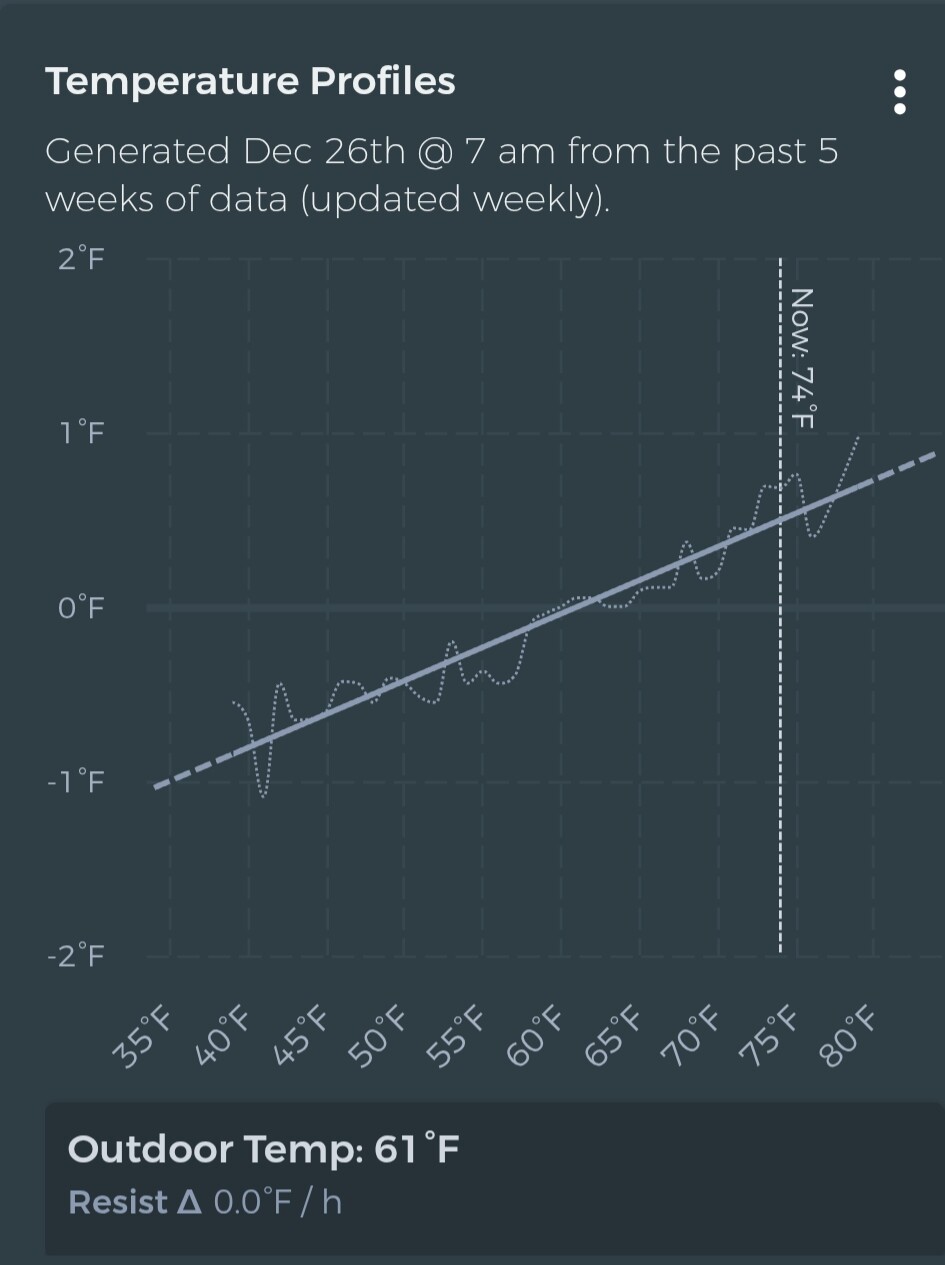
If I understand correctly, there’s technically a different balance curve for each set point, although the set points tend to be close to each other in practice so it doesn’t matter too much. In the graph you show it says that it’s 74F outside right now, and that if you were to bring your inside temp to the average setpoint of the past 5 weeks and then turn off the heat/cool you’d end up gaining 0.5F an hour until your inside temp balances the outside temp (because of passive heating or cooling that might be somewhat higher or lower than 74F)
Ok, thanks. In some much older posts, i see some users post curves for both cooling and heating (different curves). I assume this feature doesnt exist anymore?
And, how to compare my resist balance point with other similar homes? I live in the Houston area, so we have very infrequent need for furnace, but cooling is the primary electrical load and of most interest. When thinking about cooling loads, a higher resist balance point would seem to be best. I’m only 5 weeks in with this thermostat, so maybe i need to see what it looks like in Summer months before trying to make sense of it.
My goal is to compare to other homes to see where I stand in hopes of justifying whether to invest in additional attic insulation, etc.
I think you just didn’t use cooling enough to have enough data for the cooling curve. It will probably show up once you start using it more. You’re right, it will be very different from the resist curve, since it’s a combination of your house’s insulation and your equipment’s power. The zero crossing for the cooling curve is the outside temp where your equipment stops being able to keep up and just barely keeps the existing indoor temp over time. Above that, your house will slowly gain heat even as your AC will be running non-stop.
Essentially, you want that point to be the highest temp that ever happens in your area. Practically, you want it quite a bit higher than that, because cooling by 1 degree per hour is painfully slow when the temps are in the 90s and you want it to get cool at some reasonable point in the near future.
1 Like